
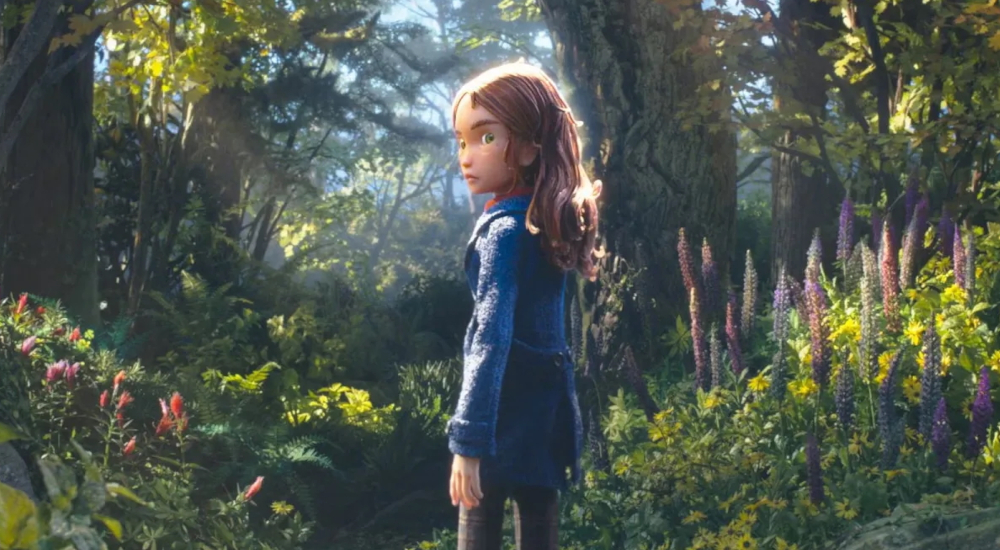
“What brought you into these woods?”
Capturing the heart and soul of its characters, Travis Knight’s Wildwood is an ambitious and oversized testament to the human hand. Navigating the complexities of grief, heartache, war, and dark magic, the film expands the boundaries of stop-motion animation, weaving an impeccable quilt of human emotion while delivering a thrill ride unlike any other.
The film centers on Prue, voiced with pristine confidence and valor by Peyton Elizabeth Lee, a young girl tasked with babysitting her baby brother, Mac. Though she agrees to keep him indoors, she almost immediately breaks that promise, packing the toddler up to enjoy a walk through the neighborhood. That is where trouble begins: a murder of crows swoops down and kidnaps Mac, carrying him deep into the Impassable Wilderness, an enchanted forest just beyond Portland, Oregon.
What begins as a rescue mission quickly becomes a story with much larger implications. With an entire civilization hidden beyond the fog, Prue and her classmate Curtis (Jacob Tremblay) find themselves caught in a brewing conflict, with the forest’s future hanging in the balance.
Carey Mulligan steals the show as Alexandra, the Dowager Governess, an exiled sorceress and the film’s primary villain. It is her grief over her son’s death that fuels the narrative, driving her determination to use dark magic to find and resurrect him. Her war is taking shape, and her orders carry an insurmountable weight as she works tirelessly to control the ivy and carry out her objective.
Note: Wildwood is dark. Very dark. Laika’s first PG-13 film leans hard into its themes, embracing its subject matter as it delves into the complexities of grief, heartache, pain, and depression. But it does so with such heart and soul that you often forget you’re watching animation.
Based on the book of the same name by Colin Meloy and Carson Ellis, Wildwood packs a tremendous punch. Though the film is the longest stop-motion feature to date, running over two hours, it embodies a lot in what feels like a quick runtime. Though its story is grand on nearly every scale, the film’s backbone rests on its immaculate attention to detail.
In a world increasingly defined by AI shortcuts, Wildwood showcases the art of the human touch. Meticulous craftsmanship brings emotion and heroism to the forefront. As you watch the spectacle unfold on screen, awestruck by its sheer magnitude, you can’t help but appreciate the minute details that bring it all together.
An iconic battlefield scene in the film’s high-powered third act is executed with such painstaking precision that I’m still scratching my head over how the crew pulled off such a wild, ambitious endeavor. But that is what Wildwood is: an ambitious, larger-than-life expedition that pushes the medium forward.
Credit Knight for his work here. Wildwood could have been a mess. But the adaptation never comes close to that threshold. Instead, the narrative is concise, its intention unwavering, and the final product impressive beyond measure. An embarrassment of riches, this emotionally charged film never shies away from the dark realities of grief, showing just how powerful and effective stop-motion animation can be.