
“Please let today be my day.”
Set in the near future, following the events of World War III and the removal of the internet, Taika Waititi’s Klara and the Sun centers on Klara (Jenna Ortega), a B1 Artificial Friend who wants nothing more than to find her perfect match. She’s overstayed her time at The Friend Store and lives in constant fear of being melted down for scraps.
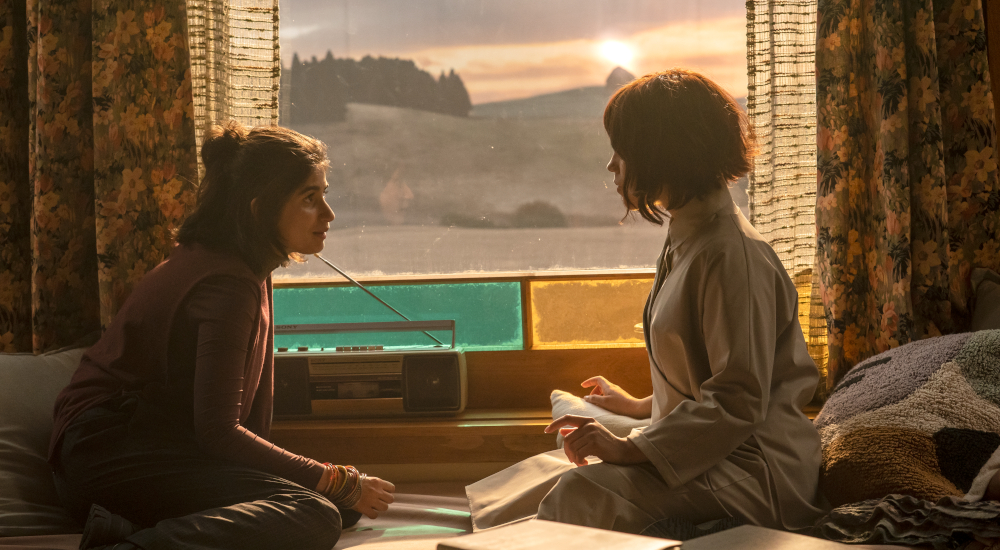
Enter Josie (Mia Tharia). Young and brimming with curiosity, Josie is immediately drawn to Klara’s uniqueness as she peers through the storefront window. The two appear destined for one another, even as Josie’s mom (Amy Adams) struggles with the decision.
Adapted from Nobel Prize-winning author Kazuo Ishiguro’s 2021 dystopian science fiction novel of the same name, Klara and the Sun is a delicate story that requires a delicate hand. While Waititi has experience in this space, the transition between mediums doesn’t do the story justice. The film fails to counter its soft, innocent energy with the horrors of how chaotic the world has become.
Staying close to the surface, Waititi and co-writer Dahvi Waller attempt to craft a balanced world. But Klara’s naïveté and simplicity are overshadowed as the film struggles to blend the intricacies of teenage female friendships with the physical comedy of an older-generation robot experiencing the world for the first time.
Waititi, known for his whimsical, quirky style, fails to do justice to the source material that presents a dark, haunting world filled with devastating consequences and high-stakes situations. Instead, we never feel that our characters are in any real danger, even as they navigate a wheat field to reach a nearby barn that houses the sun (and a Cootie).
As the seemingly dark, somber world begins to take shape, thanks in large part to Josie’s offhand remarks, little natural curiosity drives further exploration. Klara, still adjusting to her surroundings, is loyal to a fault. She accepts statements as facts, rarely digging beneath the surface to understand the how, when, and why of any given situation. As a result, we learn surprisingly little about our key players, leaving them with little depth, maturity, or purpose.
Furthermore, we feel disconnected from the characters when they eventually do experience moments of raw emotion. When Klara has her first encounter with death, our hearts momentarily break as a small computer chip desperately attempts to process and understand what has happened. But that moment passes quickly, replaced by a silly, immature interaction that is both odd and bewildering. The chaotic back-and-forth between a computer-centric learning tool and a heartfelt, human-level friend longing for a place to belong creates tonal whiplash that becomes increasingly exhausting as the film progresses.
Soon after, as the story’s big reveal comes into focus and Waititi pulls hard at your heartstrings, you realize you aren’t all that invested. Granted, Klara is a robot. A highly competent robot at times, but a robot nonetheless. Her feelings, innocent and pure, never resonate. But that, at least, makes logistical sense.
The surprise is that the same goes for Josie. Well, not the robot part. But the lack of depth and connection is consistent. Even when she discusses her lifting procedure, a gene-editing operation exclusive to the very rich, she does so with such a flippant air that you can’t help but loosen the reins on your sentiments.
It’s unfortunate, really. The ensemble is exceptional. But even they can’t decipher what Klara and the Sun is supposed to be. Part heartfelt coming-of-age drama, part physical comedy, the bipolar effect is real. While we all know what it could have been, under Waititi’s watchful eye, the adaptation becomes a tragic misfire, lacking heart, emotion, and soul. Even that would frustrate Klara.