
“It’s always been just the two of you.”
Steven Spielberg is finally returning to his sci-fi roots, as Disclosure Day gives audiences a strong, compact story that, while unable to reach the apex of his previous work, showcases exactly how a summer blockbuster is crafted. Returning to the style and aura of his late-’70s and early-’80s masterpieces, Spielberg captures the era’s essence and tone, repackaging it as a captivating chase thriller that, while not perfect, reminds viewers of the excitement of theatrical viewing.
Set in the present day, Disclosure Day marks the convergence of two separate, though highly connected, stories. One centers on Emily Blunt’s Margaret Fairchild, an ambitious Kansas City meteorologist who can’t quite sit still. The other follows Daniel Kellner (Josh O’Connor), a data security expert turned potential whistleblower. Though neither is aware of the other, their paths are predestined to cross as Kellner works to reveal how a government-adjacent corporation, Wardex, has suppressed information about the existence of aliens across the universe.
The film opens boldly, as Kellner sits nervously watching a wrestling match. Initially shot from a fighter’s POV, the camera eventually breaks away to introduce us to one of our leading players. The large-scale metaphor of a violent world, both unrelenting and unpredictable, is not lost on the viewer. And the dramatic introduction serves as a reminder that, while Spielberg is known for his ability to channel the heart and soul of his characters, the Saving Private Ryan and Jaws director is not a stranger to the exhilarating action shot. There are plenty of those here to go around. And many of them are exceptional.
But the expensive, high-octane shots cannot overshadow the somber, murky writing, which consistently drags the narrative down. Even if viewers can get past the pesky, unrealistic chase sequences, the film constantly feels as if it’s in overdrive, maneuvering at a pace that forgoes the details in favor of the big picture. Things happen on a whim, and we’re rarely privy to how characters arrive at their conclusions or why certain moments carry the weight they’re seemingly intended to have.
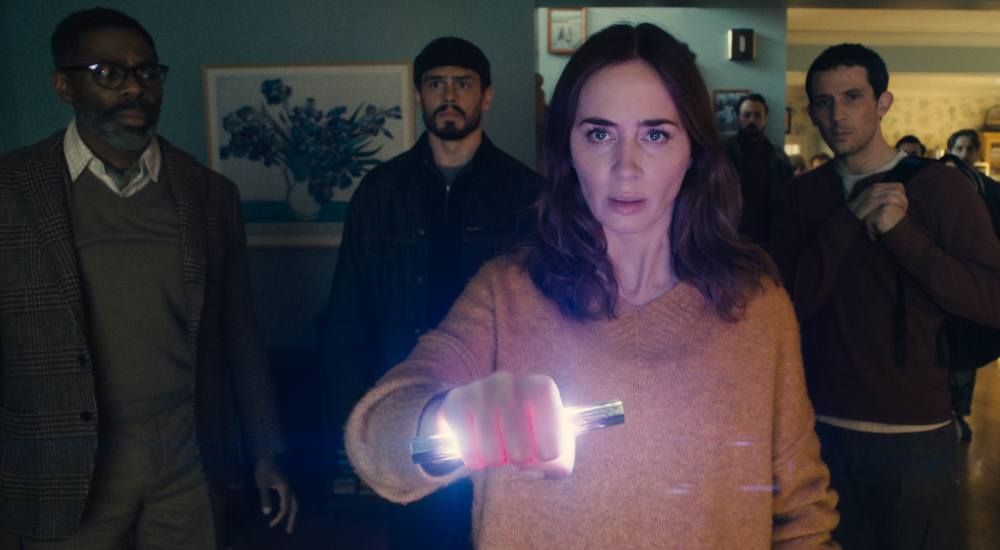
A prime example is an alien artifact, roughly the size of a remote, that allows Scanlon (an often overreaching Colin Firth) to dive into the consciousness of characters, manipulating their minds for information and prompting action. The same gadget also allows others to share cognitive memories, become invisible (but not bypass a heat scan), and jumpstart jammed power grids. It is, without question, a narrative get-out-of-jail-free card that writer David Koepp employs without hesitation. And while it is, at times, interesting, it is hardly feasible, especially within a film that already asks audiences to accept one implausibility after another. The result is a story that often feels forced, relying on convenient explanations rather than earning its biggest moments.
However, amid the chaos, there is still a ton to enjoy in Spielberg’s first film since 2022’s The Fabelmans. Aside from the brilliant (read: expensive) set pieces that keep the story visually engaging, both Blunt and O’Connor are in terrific form, capturing the body and soul of the story. Though neither of their characters fully understands the scope of their involvement, their chemistry is strong as their lifelines become beautifully interlaced. It is the kind of human connection that Spielberg has built his career around, and it gives the film an emotional pulse that the screenplay occasionally struggles to find on its own.
While this likely won’t be remembered as one of Spielberg’s strongest works, his fingerprints are all over it. Heartfelt and optimistic, Disclosure Day is a big-picture project that raises questions about our role in the universe. And while it is sure to spark discussions about the power of knowledge, it will also prompt us to question our conviction that we humans are truly alone in the vast universe. Perhaps that is the film’s greatest strength: even when its story doesn’t hold together, its sense of wonder does.