
“I’ll help you find her.”
Love is both comprehensive and intimate. We’ve all felt the absence of it, and the power it can possess. Yet, even with so much knowledge about the emotion, there is little diversity in its depiction, especially in film. Alicia MacDonald’s Finding Emily does little to move the needle, sticking to the tropes that have engulfed the rom-com subgenre for decades. But here the playbook works to a very limited extent, creating a fine, though not particularly good, piece that hinges on the chemistry between its two main leads as they navigate their own love journeys.
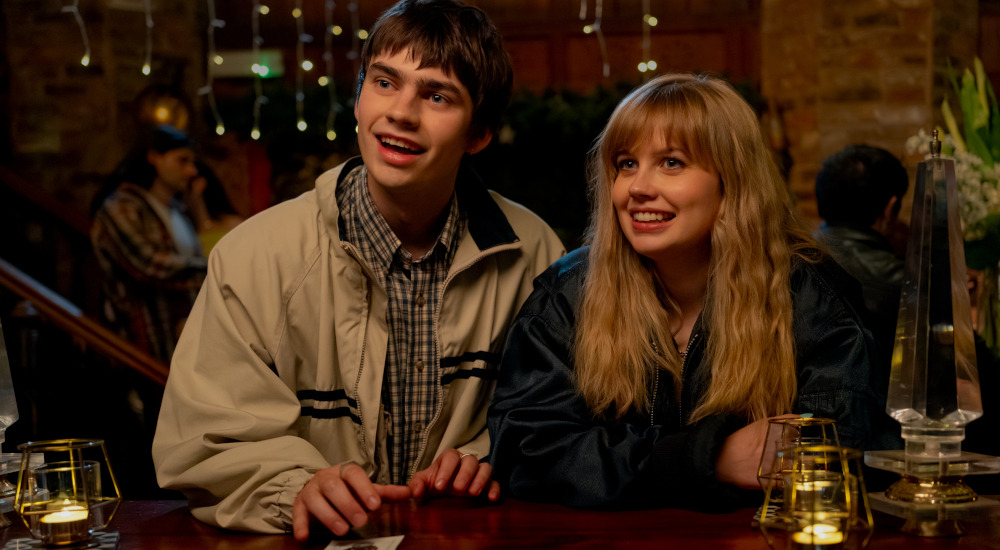
Spike Fearn stars as Owen, a sound engineer who, while on shift, experiences the ultimate meet-cute with a young woman he knows nothing about. The connection, magical as it may be, is quick. Dressed like a fairy, she personifies the moment’s dreaminess. The metaphor is obvious, the situation expected. But under the light of day, Owen discovers that his happy ending is a bit further off than he expected. The number she entered into his phone as her friends pulled her away is one digit short. A follow-up text is, for lack of a better word, impossible.
But Owen is determined. Knowing nothing beyond her name (Emily) and her school (Manchester City University), he crafts a plan to track down the love of his life, committing to the campaign because he feels destined to turn his serendipitous encounter into a full-blown love story.
Enter Angourie Rice’s Emily. No, not that Emily. A different Emily. One who doesn’t believe in love. Or romance. Or proper research ethics.
While the story, at its heart, straddles the line between creepy and endearing, Finding Emily struggles to forge its own path, painfully staying within the strict boundaries of traditional rom-com entries. Even as the film works to incorporate weightier themes involving rape culture and toxic masculinity, it struggles to move beyond the very conventions it is attempting to examine.
Moreover, Owen, in his dreamy state of love and despair, isn’t the most off-putting character here. That title goes to Rice’s Emily Raine. Pulled out of class in a classic case of mistaken identity, she allows her pessimistic outlook on love to drive the narrative in a rather unhealthy direction. In the eleventh hour of a so-far botched thesis paper meant to “prove” that love is a useless, self-sabotaging state of psychosis, she disregards her moral integrity, heavily influencing her newly discovered subject in an attempt to secure a splashy, self-serving result that will put her in good favor with her self-righteous professor.
While Finding Emily could have kept things light and easy, writer Rachel Hirons repeatedly doubles down on the process, attempting to make the film something more than it is. Mixing modern buzzwords with old-fashioned story elements, the film becomes bogged down in its own self-consciousness as it tries to compensate for unlikable characters who, as one would expect, begin to fall for one another.
By the time the third act arrives, there is little for director Alicia MacDonald to unveil. Sure, the actors themselves are likable. And they do amazing work with the material they are given. But even as we begin to root for their eventual success, their interactions seem forced and their obstacles too grand. And in a world where the grass is often greener, Owen’s obsession with his long-lost Emily feels desperate and forced. As for the newly minted Emily, her heart is closed. It must remain that way. Her entire career depends on it. The film’s insistence on pretending that the conversation is still up for debate is the most fundamental issue that makes Finding Emily a little sweet romance and a lot of a headache.