
“The revolution begins tonight.”
Absurd and unhinged, Gore Verbinski’s Good Luck, Have Fun, Don’t Die marks the American filmmaker’s return after a nearly decade-long hiatus. And while the story is a far cry from his Pirates of the Caribbean films, its creative energy is captivating as he examines the future of AI through a unique lens.
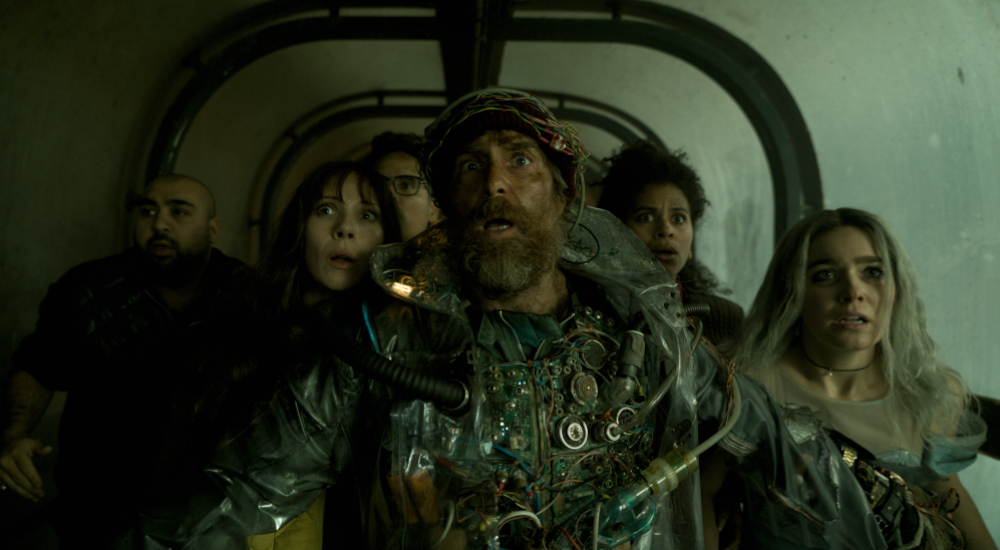
Sam Rockwell stars as self-proclaimed “The Man from the Future”, a time traveler who arrives unexpectedly at Norms, a Los Angeles-based diner, to recruit a group of patrons for a mission. The objective: Evade the future dystopia from which the eccentric man claims to come.
While those in the diner feel they are experiencing this bombardment for the first time, this is actually the 117th intrusion by the mysterious man with a bomb strapped to his chest. Those earlier missions failed. But tonight could be different. Tonight’s ensemble could be the one.
As Rockwell navigates the diner, offering an incredible monologue to catch everyone up on the direness of the situation, we begin to slowly piece together the scene. And as we are introduced, in fairly slow motion, to our eventual group, you can’t help but appreciate the wealth of talent on hand.
Taking the preverbal leap with Rockwell are two exhausted teachers (Zazie Beets and Michael Peña), a grieving mother (Juno Temple), a rejected princess (Haley Lu Richardson), a scout leader (Daniel Barnett), and a rideshare driver (Asim Chaudhry). Individually, they represent little in the world of combat. But tonight they will attempt to right the world and prevent hell from breaking out of our computer screens.
While I credit Verbinski for his impeccable return, Good Luck, Have Fun, Don’t Die lives and dies by the performances of its star-studded cast. Balancing sadistic comedy with the threat of global extinction, this is ultimately Rockwell’s movie. The star earns top praises for his immaculate performance, bringing heart and humor to the screen as he frantically navigates the rough terrain, guiding a group of unknowing volunteers through a colossal shitstorm in an attempt to embed a line of code at a precise moment to combat the birth of an evil artificial intelligence.
There’s a ton of trust happening here. For viewers, it’s wild. But somehow, within the context of the story, it feels standard. Routine even.
As the group begins its quest, the film builds the fictitious world around them. As we become introduced to our primary players through a series of character-centric flashbacks, we discover the nuances of this fantasy place that, albeit a satirical take on society, isn’t too far removed from where we sit today.
In fact, an unapologetic sci-fi comedy with an important message at its core, Good Luck, Have Fun, Don’t Die isn’t nearly as futuristic as it's intended to be. Screenwriter Matthew Robinson penned the first draft in 2017. At that point, generative AI wasn’t a huge threat. Fast forward nearly a decade, and the accelerated growth of technology grounds the film’s overarching narrative.
But even with the threat of unintentionally dating the film’s storyline, Verbinski beautifully walks the tightrope of keeping things broad and undefined while driving home his primary point regarding our use, reliance, and obsession with technology. The coalition of genres is artfully achieved while the technical imperfections and low-fi aesthetic give the film a rawness rarely seen in today’s landscape.
That presentation perfectly underlies the fact that, amidst the reboots, remakes, sequels, threequels, and other IP-obsessed projects that dominate the big screen today, Good Luck, Have Fun, Don’t Die is a rare piece of counter-programming that viewers should embrace, support, and appreciate. It is a true marvel.