
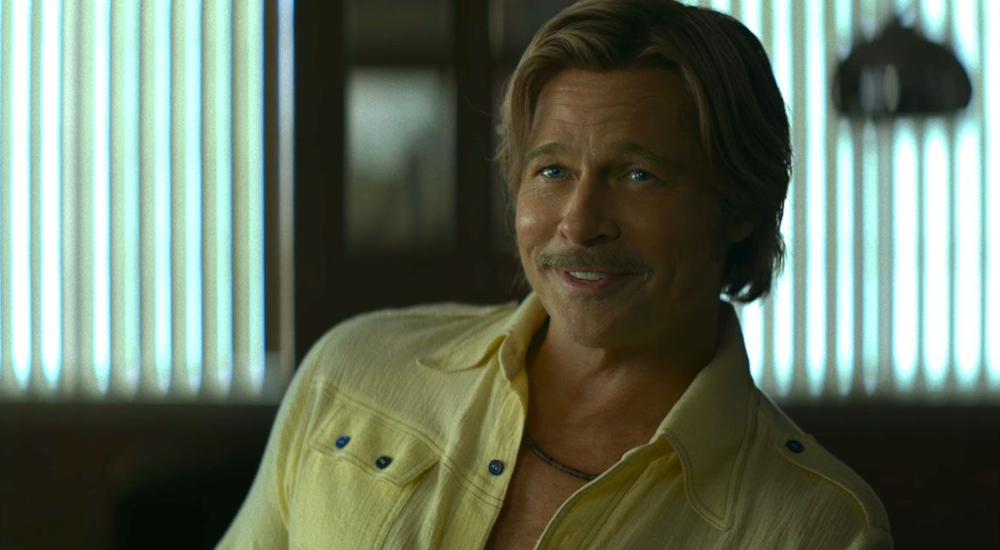
Once again, we face the prospect of a sequel to a beloved movie with an almost entirely new cast, plus a new director behind the camera. And once again that director has made some questionable choices, while the writer's strengths and weaknesses are on full display. But once again the highs are so high, I can't help but overlook the new film's glaring flaws.
The Further Mis-Adventures of Cliff Booth is an apt title for a movie that's extremely episodic and, for better or worse, follows Brad Pitt's ex-stuntman in nearly every scene. Pitt is as charming and self-deprecating as ever, but it suffers from not having a performance as soulful as Leonardo DiCaprio's in Once Upon a Time in Hollywood. His Rick Dalton has moved to Australia with Francesca, leaving Cliff without steady employment and out of the movie business altogether. So he fills his nights with odd jobs, including running a movie theater, bartending, stunt driving, and occasionally some illegal activities. Many of these scenes, despite serving almost no plot function, are electrifying if you're on the film's wavelength. (But if you're over Pitt, Tarantino, or Fincher, these will be a drag.)
But let's talk about Fincher. He's worked with Netflix exclusively for more than a decade now, delivering the acclaimed Mank and the underrated The Killer, as well as my beloved Mindhunter. As a filmmaker, he's often obsessed with control. He requires actors to do dozens of takes. He likes to film on sets wherever possible, the better to avoid unpredictable things like weather and light. And he loves to be at the forefront of new technology, with his DPs shooting exclusively on digital for two decades.
That cold look works for most of his projects, but it doesn't exactly mesh well here. Tarantino's perfectionism drives him to do things like shoot on multiple film stocks, meticulously recreate long-closed eateries, and write entire scripts for a fictional TV show. Fincher doesn't seem to care about any of that. If he can create the shot he wants with VFX, he'll do it that way, even if it looks terrible. (There's a fight scene in the third act that rivals Marvel for its ability to have you asking, "the budget was how much and it looks like that?!")
All that said, the film is endearingly shaggy. Its major story doesn't even start until halfway in, and its resolution might leave a lot of folks dissatisfied. But all the little moments along the way make the movie sing. Things like Cliff and Hollywood agent Karen Crosby (Elizabeth Debicki) declaring their attraction via song dedications on the radio. Or Cliff holding a would-be thief at gunpoint and yelling at him to "scooch." And the wonderful interplay between Cliff and his aging father Gus (Peter Weller). All of this is magnificent, and if the movie simply looked better and got its production details right, it would rival its predecessor.
Now it's likely that the film's visual weaknesses – including alleged generative AI use – won't be quite as noticeable at home on Netflix instead of a giant IMAX screen. What will shine are the film's impeccable vibes, enjoyable performances, and whip-smart humor that undercuts the darkness. I never thought I'd write this, but if they get someone besides Fincher, I'd be thrilled to see even more of Cliff's misadventures.