
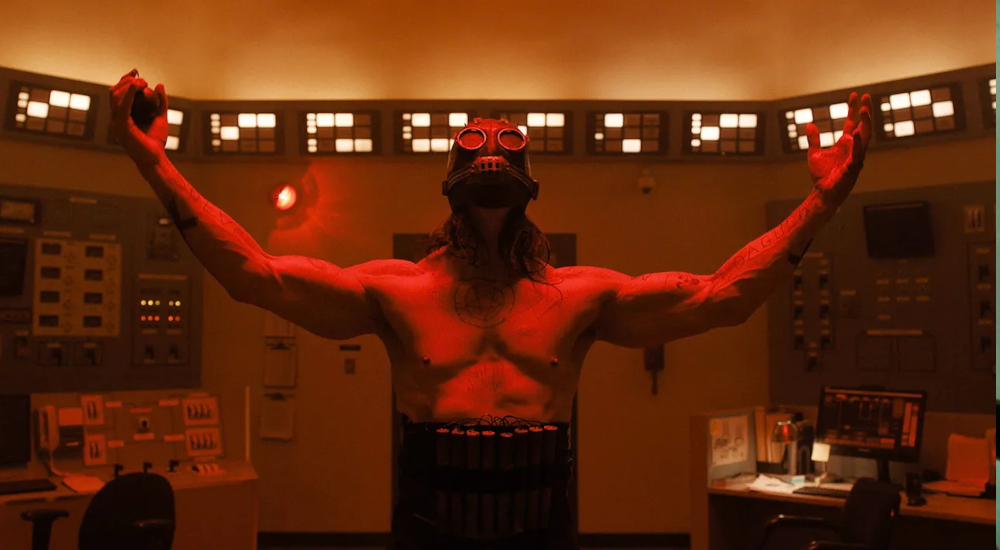
“Have you come to confess?”
Capturing the unique tone and punch of a Rob Zombie goth-centric film, Gavin Polone's Psycho Killer leans heavily into the religious underbelly of Satanism. While the film struggles to find its way through a rift of adolescent impulses that deprives the dark narrative of room to breathe, one cannot ignore the ambitious attempt to thwart social norms and aim hard—and fast—for the jugular.
Georgina Campbell stars as Jane Archer, a Kansas highway trooper who, after witnessing her husband's brutal murder, vows vengeance against the fugitive known only as the Satanic Slasher, played in dominating fashion by James Preston Rogers.
Campbell, a genre veteran thanks to her work in Barbarian and Black Mirror, embodies the role of a grieving widow with valor and courage. A mere two days after laying her husband to rest, she sits in a therapist's chair, performing her required duties, with retribution the only thing sitting squarely on her mind.
And while everyone watching knows where the film is headed—a heated, cross-state manhunt led by a partner suffering silently, her anguish and sorrow seeping from every crevice—there's a black, murky essence that exists beneath the story's surface.
It is here that the film dives deep into its strangely constructed underworld. The Satanic Slasher is, above all else, a large-scale mystery. Bearing a "no mercy" tattoo on his left hand, he maneuvers his way through the film wearing a mask, his face forever hidden from those watching. Even as he sidesteps authorities, easily dominating his victims without any serious threat to his own safety, questions begin to arise. The most prominent one? Just how towering is he?
And that is where the problems begin.
While thematically interesting and artistically shot, Psycho Killer leaves far too much open to interpretation. Even as the story delves into the demonic world of evil and diabolism, Polone works to keep things broad, leaving the viewer to interpret key elements as our villain roams the streets, killing seemingly at random and at will.
Written by Andrew Kevin Walker of Se7en fame, the story contains all the necessary elements to be considered good. But something feels off. With a unique, muted color palette and an undeniable '90s feel, the film bears a sinister, demonic aura. But things never materialize beyond surface level, leaving audiences scratching their heads as the absurdity unfolds onscreen.
Real-world authenticity aside, the film does occasionally work. But it continuously struggles to answer the important questions that would ultimately shape this world and create a sense of understanding around our characters and their often nonsensical choices.
Undoubtedly, Archer is acting on emotion. Hellbent on vindicating her husband's death, she longs for another chance to pull the trigger and deliver the fatal shot that will close the case and bring a sense of comfort to the communities affected by the sudden string of brutal slayings. But her fervent, singular motive grows thin as the film progresses, opening the door to even more audience uncertainty as she repeatedly seeks help from local authorities while bypassing standard procedures. She's often frustrated by their unwillingness to follow her own unsupervised set of rules, constantly placing herself in harm's way as she appears blinded by her elevated emotional state.
After a rather eventful visit to a local community house, our killer heads toward his final destination. Archer, feverishly nipping at his heels, is in hot pursuit. Having presumably placed the final pieces of the case's puzzle into place, she appears to have gained an understanding of the mind and motive behind our otherwise mysterious figure. Unfortunately for the viewer, she keeps much of that knowledge to herself, leaving us confused and, honestly, disinterested in the forthcoming confrontation.
But even that high-stakes moment proves rather anticlimactic.
Granted, the final visuals are vicious and obscene. Genre fans will appreciate the imagery. But after almost ninety minutes, that doesn't mean much. Walker has a reputation to uphold. I can’t say he does it well here, as he’s s unable to recreate the lasting effect he had on audiences in September 1995, when Mills, standing in the middle of a desert, found a severed head in a cardboard box.
And though this film bears many visual similarities to that cinematic masterpiece, the stories don't translate. Se7en understood how to make its darkness feel purposeful. Psycho Killer seems content to simply revel in it.