
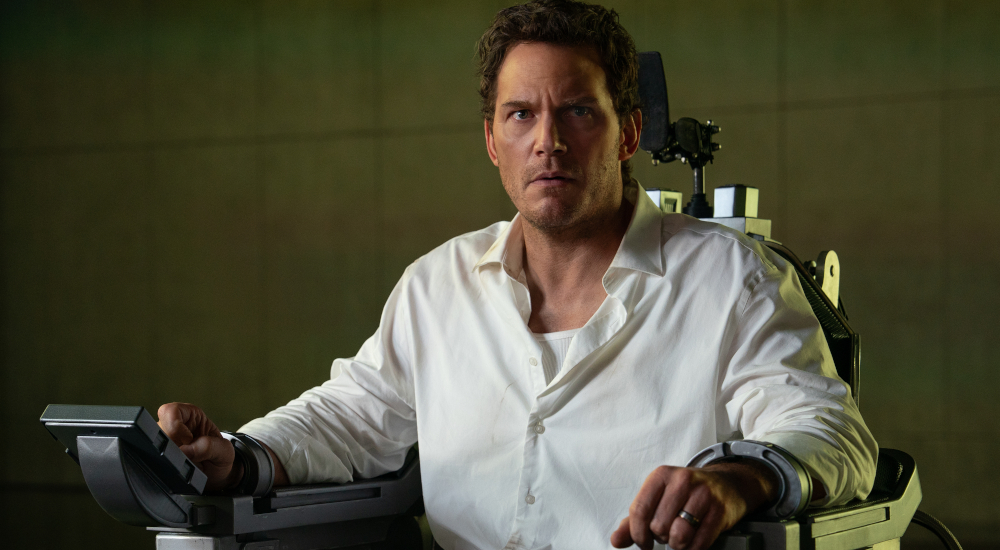
"I'm fucked."
In 2002, Tom Cruise and Steven Spielberg teamed up to showcase the power and dangers of technology in Minority Report. Now, amid a fury of AI advancement, Chris Pratt and Timur Bekmambetov look to do the same with their muted and eventually unconscionable Mercy.
Set in the near future, Pratt plays Chris Raven, a detective accused of murdering his wife during a crime of heated passion. While he maintains his innocence, the probability of his guilt is beyond the threshold required to trigger a Mercy Court trial. The guilty-until-proven-innocent court proceedings take place before Judge Maddox, an advanced AI judge (played by Rebecca Ferguson), whom he helped create. He has 90 minutes to prove he didn't kill his wife or else find himself sentenced to immediate execution.
As viewers, it takes time to slowly unravel the details of the case as Raven works to rehash the events of the day before. While he stumbles out of the gate, the timer ticking down on the screen in front of him, Judge Maddox urges him to use a glut of resources that the citizens of Los Angeles have voluntarily provided to the Court.
Strapped to a chair, we venture outside the isolated room via video calls and archival footage from cell phones and security cameras. It's a unique use to showcase the lack of privacy that comes with technology, one made all the more apparent as our protagonist sifts through a mountain of files and screens he has access to. To many, the sheer amount of data available will be overwhelming. Still, the film does well to organize it visually, helping viewers grapple with its extensive scope.
A fun investigative thriller, Bekmambetov does well within the story's confines, even if more than a few elements fall into convenient coincidence. But as Raven begins to cycle between defeat and renewed hope, he leans on Judge Maddox to stay focused on the job at hand. Occasionally, Maddox shows signs of going against protocol as she appears to display moments of learned human emotion. But even with the lighter tone, Raven's guilt stands strong, unwavering as he attempts to eliminate possible suspects and clear his name.
Though the film is rudimentary in its story points and never ventures too far outside the proverbial box, Mercy is, for the first hour, an enjoyable experience that is just engaging enough to work. But then we venture into the third act and screenwriter Marco van Belle decides to overcomplicate things, throwing logical integrity out the window as he strains to craft an ending to Case 19 that matches the film's earlier moments.
While I'll always welcome a third-act twist, the story didn't warrant a laundry list of discoveries. Pratt and Ferguson were aptly holding down the heavily structured narrative, giving fans a simple, straightforward viewing experience, when Mercy jumped the rails. The heightened ridiculousness of everything on screen leaves us perplexed as the characters begin to act irrationally, forcing the film to pull into the station wild and sluggishly. And though viewers likely won't get bored during the journey, the ride lasts ten minutes longer than necessary.